
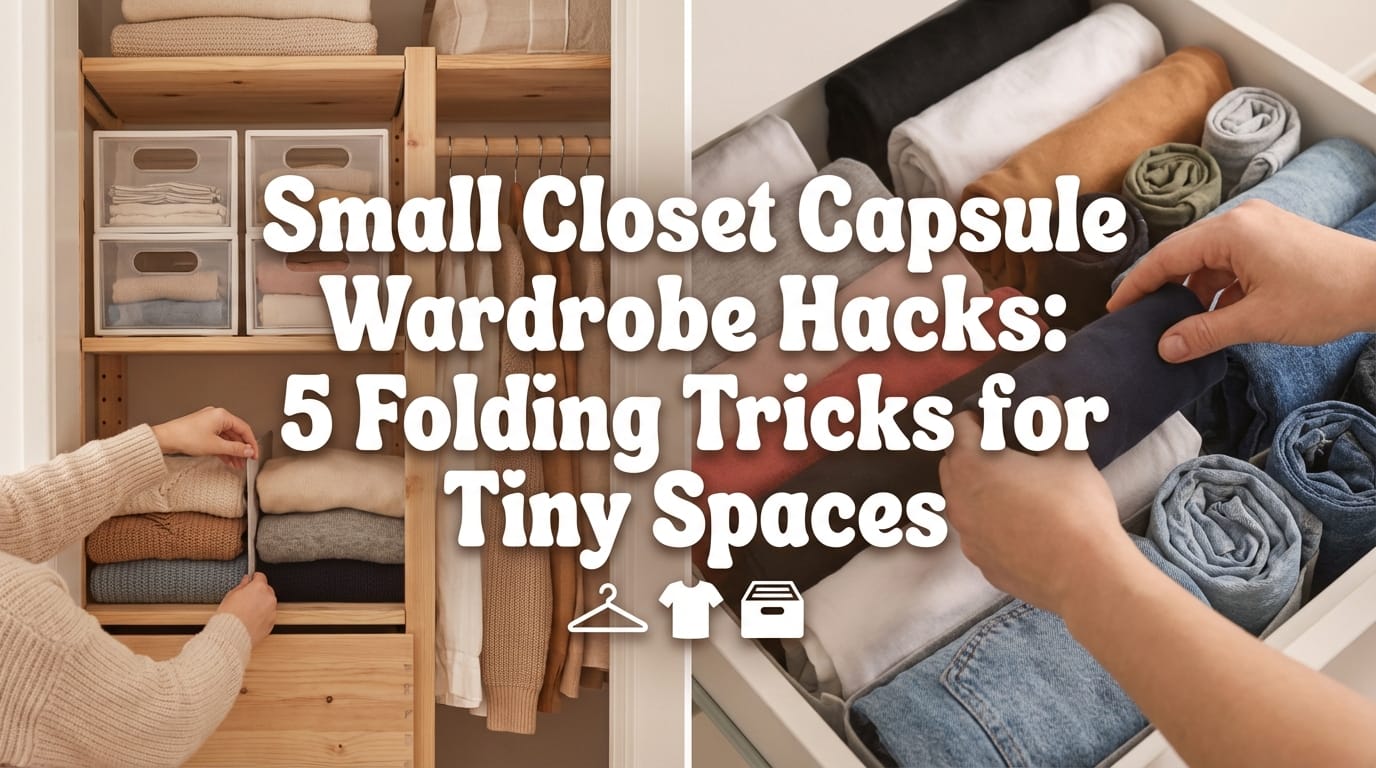
Your closet shouldn’t look like it lost a wrestling match with a laundry basket. And yet… here we are. If you’ve got a tiny closet and big “I’ll deal with it later” energy, I’ve got you.
I’ve built capsule wardrobes in spaces that basically qualify as “coat rack with a door,” and folding made the biggest difference—more than buying more bins, more hangers, or more “organizers” that somehow create less space. Ever wondered why your closet feels full even when you swear you own “nothing”? Yep, same.
Let’s fix it with 5 folding tricks that play nicely with a capsule wardrobe—simple, practical, and annoyingly effective.
Why a Capsule Wardrobe Saves a Small Closet (and Your Morning Mood)
A capsule wardrobe keeps your closet tight and useful: fewer pieces, more outfits, less chaos. Most capsule guidelines land around 30–33 versatile pieces, and some folks aim for 35 items or fewer in active rotation. That number doesn’t magically change your life, but it does force you to stop storing “maybe someday” clothes next to your everyday favorites.
When you pair a capsule mindset with smart folding, you get:
- Less visual clutter (your brain stops screaming at 7:42 a.m.)
- Faster outfit picks (because you can actually see what you own)
- More usable space (not “more space,” just space you can access without rage)
And honestly, accessibility matters more than raw square inches. What good serves a shelf if you hate opening it?
My quick capsule rule (that keeps me honest)
I keep:
- Everyday favorites front and center
- “Nice but not essential” items in a separate holding zone
- Off-season stuff out of my active closet
Do you need a strict number to do this? Nope. Do you need a system? Absolutely.
Small Closet Space Efficiency
Comparing Folding Methods for Maximum Storage in Tiny Spaces
📊 Key Takeaways
Folding Trick #1: File Folding (Vertical Folding) So You Can See Everything
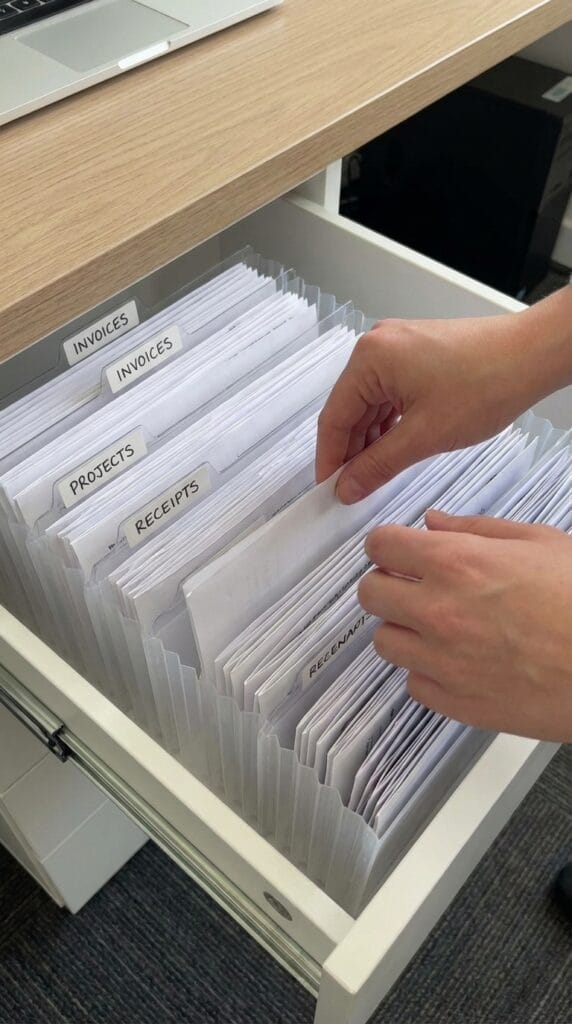
File folding (aka vertical folding) changes the game for small closets because it stops the dreaded “stack collapse.” You know the one: you pull one shirt and the whole pile slumps like it just gave up on life.
Why it works so well
You store items upright like little clothing files. You see everything at a glance, so you stop digging and re-folding (aka making the mess worse).
How I do it (fast and realistic)
- Lay the item flat.
- Fold sides inward to form a neat rectangle.
- Fold into thirds (or quarters) until it stands upright.
- Line items up vertically in a drawer, bin, or shelf.
Best items for file folding
- T-shirts and tanks
- Workout clothes
- Pajamas and loungewear
- Light sweaters
Rhetorical question time: if you could see every tee you own in two seconds, would you still buy another “basic white one”? Exactly.
Folding Trick #2: The Half-Hanger Fold to Double Your Hanging Space
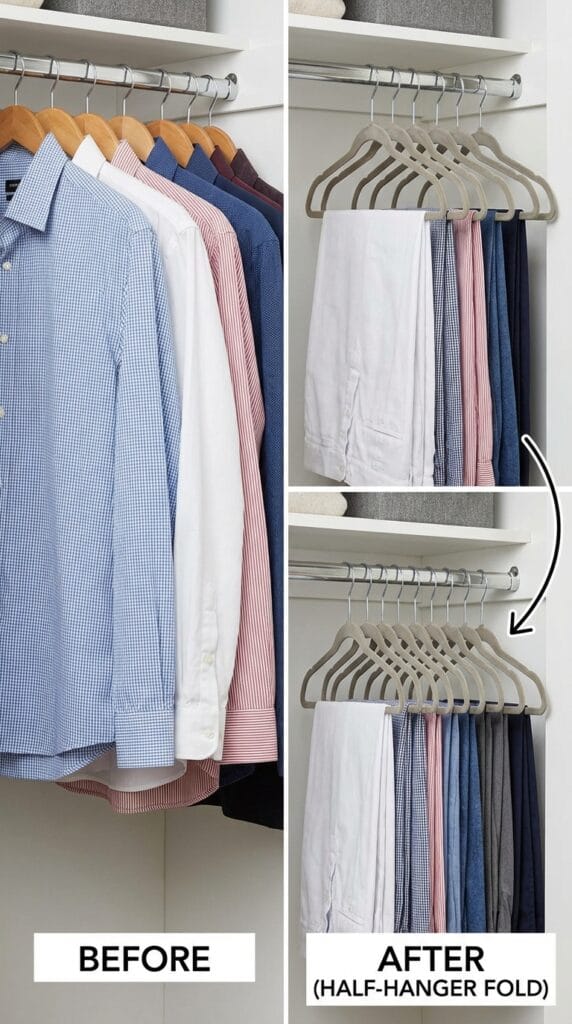
Hanging takes prime real estate in a small closet. So when long items hog the rod, I fight back with what I call the half-hanger fold.
The idea
You hang the top normally, then fold the bottom portion over itself so it takes up less vertical and horizontal space. This works especially well if your closet rod sits low or you share the space with shelves.
What I use it for
- Dresses you don’t want to wrinkle
- Long cardigans
- Wide-leg pants (when I don’t want a hard crease)
Quick tips so it doesn’t look sloppy
- Use slim velvet hangers to reduce bulk and prevent slipping.
- Keep the fold consistent so items hang evenly.
- Don’t cram. Your closet can’t “manifest” more space, no matter how positive you feel.
FYI: slim velvet hangers sound like a minor detail, but they save space and keep clothes from sliding into hanger-jumble.
Folding Trick #3: S-Hook Belt-Loop Hanging for Jeans and Pants (No More Shelf Piles)
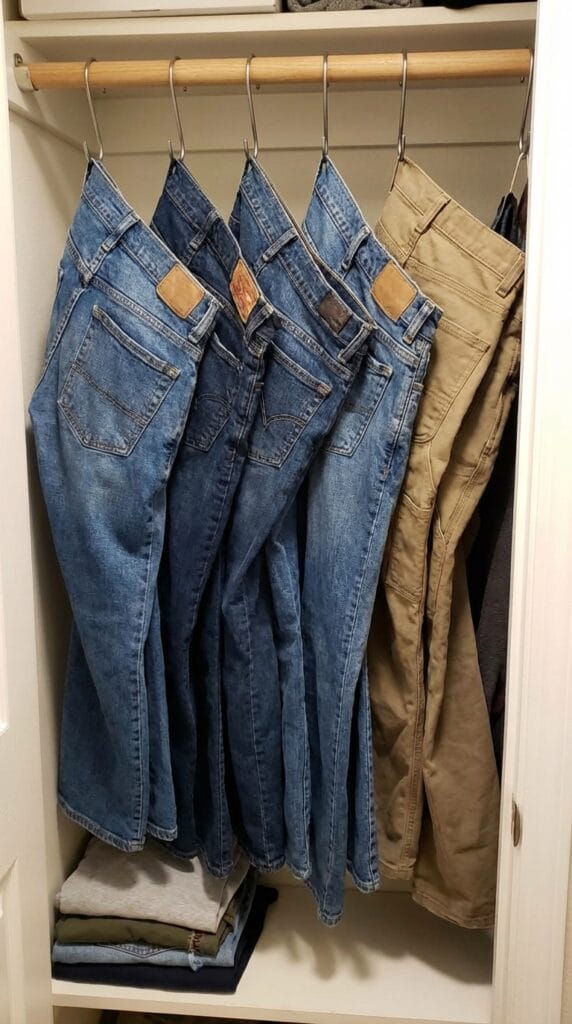
Jeans stacks look tidy for about nine minutes. Then you grab one pair and the rest go feral. I like S-hooks through belt loops because they keep pants visible without turning a shelf into denim Jenga.
How to set it up
- Grab S-hooks (basic metal ones work).
- Loop one side through a belt loop.
- Hang the other side on your closet rod.
Why it helps in tiny spaces
- You free up shelves for items that fold better
- You see washes and styles instantly
- You stop unfolding five pairs to find “the good ones”
Capsule-friendly guideline (that actually works)
I try to cap bottoms at 5–7 pairs in active rotation. If you own 14 pairs, you don’t need a better closet—you need a clearer favorite list.
Folding Trick #4: Ceiling-to-Floor Vertical Stacking (Using “Dead Space”)
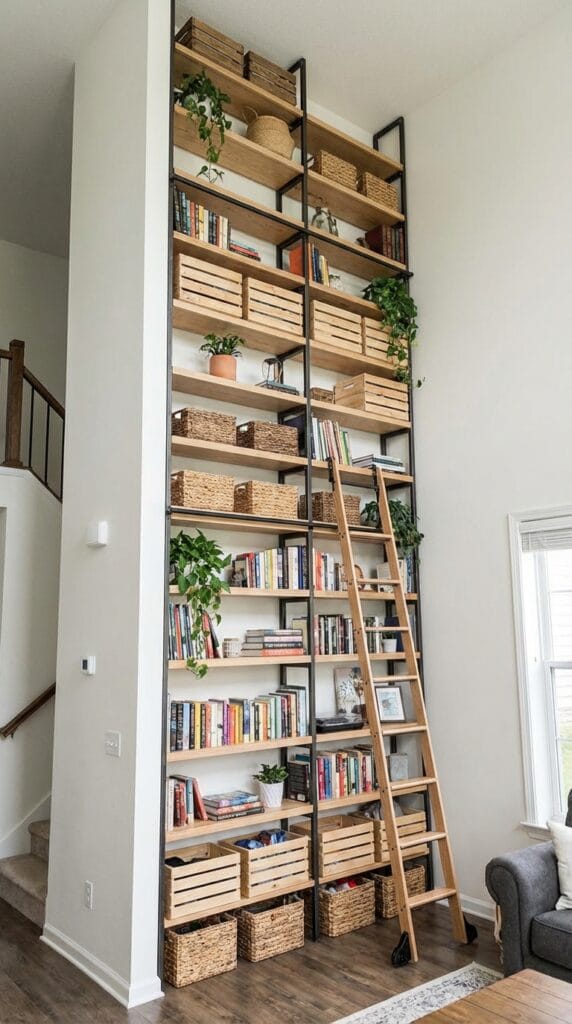
Small closets waste vertical space like it’s a hobby. You’ve got the top shelf and often the floor area, and you can use both without turning the closet into a storage locker.
The method
You fold bulky items into slim, consistent rectangles, then stack them in stable piles or bins. You keep the stacks vertical and intentional, not wide and chaotic.
What I store up high vs. down low
- Top shelf: off-season sweaters, scarves, backup basics
- Lower shelf/floor bins: gym gear, handbags, occasional shoes
Containers that actually help
I like stackable open-front containers (wire baskets, fabric bins, wooden bins) because I can grab items without removing lids. Lids slow me down, and I “temporarily” set them aside… for three months.
Mini rule that saves stacks
Don’t stack higher than you can safely pull from without toppling. I’ve learned this the hard way. Twice. :)
Folding Trick #5: Door-Back Vertical Folds for Hidden Extra Storage
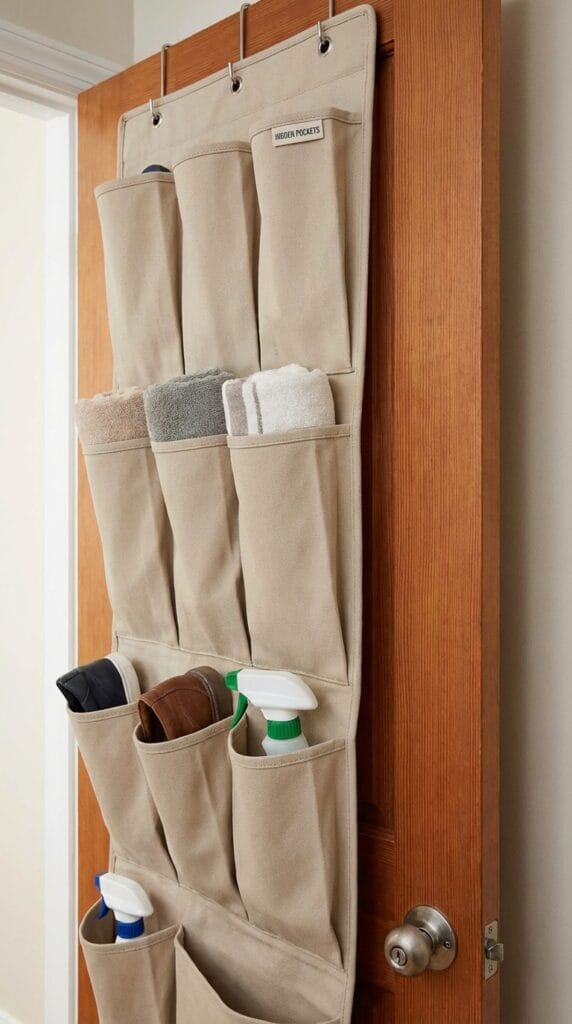
Your closet door sits there like it pays rent and contributes nothing. Let’s give it a job.
What to add
- Slim pocket organizers
- Hooks
- A narrow hanging rack
Then you store light items using vertical folds so you still see everything.
What I store on the door
- Accessories (belts, scarves, caps)
- Delicates in pouches
- Small tees or tanks in slim pockets
This trick works especially well when your closet lacks drawers. And if you think it looks “extra,” just remember: nobody awards prizes for “Most Aesthetic Closet Interior” (sadly).
Quick Comparison Table: Which Folding Trick Should You Use?
| Folding trick | Best for | Biggest benefit in tiny spaces | What to watch out for |
|---|---|---|---|
| File folding (vertical folding) | Tees, tanks, lounge, light sweaters | You see everything instantly | Overstuffing makes items flop |
| Half-hanger fold | Dresses, long items, wide pants | You reduce hanger crowding | Inconsistent folds look messy |
| S-hook belt-loop hang | Jeans, trousers | You avoid shelf piles and digging | Cheap hooks can snag fabric |
| Ceiling-to-floor stacking | Sweaters, off-season items | You use “dead space” efficiently | Tall stacks can topple |
| Door-back vertical storage | Accessories, small items | You gain space without adding furniture | Bulky items make the door awkward |
Bonus: Pair Folding With Capsule Wardrobe Success (So It Actually Stays Organized)
Folding hacks work best when you stop trying to store everything you’ve ever owned “just in case.” A capsule wardrobe gives your folding system room to breathe.
Step 1: Do a one-spot closet audit
I pull everything into one place (bed, couch, floor—pick your battlefield). Then I sort:
- Wear weekly
- Wear sometimes
- Never reach for it
If you hesitate, ask: “Would I buy this again today?” That question ends arguments fast.
Step 2: Separate by category (it sounds boring, but it works)
Categories speed up your mornings because your brain stops scanning random piles. I like:
- Work / going-out
- Casual / everyday
- Lounge / sleep
- Seasonal
Step 3: Store off-season items away from prime real estate
I keep off-season pieces in cotton bags or labeled bins. I store them on the top shelf or under-bed storage so my daily closet stays easy.
IMO, this step matters more than any folding trick. When you remove off-season clutter, your closet suddenly “grows.”
Sample Mini Capsule Layout (Built for Small Closets)
Use this as a flexible starting point, not a law carved into stone.
| Category | Suggested active items | Notes for tiny closets |
|---|---|---|
| Tops | 10–12 | File fold most; hang wrinkle-prone |
| Bottoms | 5–7 | Try S-hooks for jeans/pants |
| Layers | 4–6 | Fold bulky; hang structured blazers |
| Dresses/Jumpsuits (optional) | 1–3 | Use half-hanger fold |
| Shoes | 3–5 | Keep daily pairs accessible |
| Outerwear | 1–3 | Rotate seasonally |
| Accessories | 6–10 | Door storage works great |
If you aim for 30–35 active items, you’ll usually feel the difference immediately—especially in a small closet where every inch counts.
The “Don’t Overbuy Organizers” Starter Kit (Simple Tools That Help)
You don’t need a shopping spree. You need a few basics that support your system.
| Item | Why it helps | My take |
|---|---|---|
| Slim velvet hangers | Saves space, prevents slipping | Worth it if you hang a lot |
| S-hooks | Hang pants/jeans by belt loops | Cheap, effective, low drama |
| Open-front bins/baskets | Fast grab-and-go storage | Skip lids unless you love friction |
| Labels | Keeps stacks and bins honest | Your future self will thank you |
| Cotton bags/labeled bins | Off-season storage | Keeps active closet clean |
If you feel tempted to buy ten matching containers first, ask yourself: will the container fix the clutter, or will it just hide it? :/
Maintenance: Keep It Tidy Without Doing a Weekly Closet Reset
You don’t need a 90-minute “organization day.” You need tiny habits that stop chaos from rebuilding.
My low-effort routine
- One-minute reset: re-file fold anything that flops over
- One-in, one-out rule: when you add a piece, remove one
- Monthly quick scan: pull anything you skipped all month into a “maybe” zone
Do you know what ruins small closets? Random “I’ll deal with it later” piles. You stop those piles, and you win.
Conclusion: Tiny Closet, Big Peace
A small closet doesn’t doom you to messy stacks and hanger madness. You can build a capsule wardrobe around 30–35 active pieces, then use file folding, the half-hanger fold, S-hook hanging, vertical stacking, and door-back storage to make everything fit—and actually stay accessible.
Pick one trick and try it today. Then pick the next one tomorrow. Your closet will look better fast, and you’ll spend less time hunting for that one shirt you swear you own.
And if your closet still looks chaotic after all this? Congrats—you officially own too much stuff. (I say that with love, because I’ve been there.)